
How Many Photographers Do You Need for a Wedding?
One photographer can photograph a wedding. That does not necessarily mean one photographer is enough for your wedding.
The real question is not simply how many people can hold a camera. It is how many important things are happening at the same time, how large the wedding is, how many functions you have planned, and whether you want photography, traditional group photographs, candid moments and wedding films to be covered properly.
For a small, intimate wedding, one photographer and one videographer may be perfectly practical. For a large Indian wedding with multiple functions, a bride getting ready at one location, the groom’s preparations somewhere else, hundreds of guests and several rituals happening throughout the day, the requirement can be very different.
So, how many photographers and videographers do you actually need?
There is no single number that works for every wedding. But there is a practical way to work it out.
The Short Answer
For many weddings, a useful starting point is:
| Wedding size / requirement | Photographers | Videographers |
|---|---|---|
| Small, intimate wedding | 1 | 1 |
| Small-to-medium wedding | 1–2 | 1 |
| Medium Indian wedding | 2 | 1–2 |
| Large wedding with several functions | 2–3 | 2 |
| Large wedding with simultaneous events | 3+ | 2+ |
These are planning guidelines, not fixed rules.
A wedding with 100 guests can sometimes require more coverage than a 300-guest wedding if important events are taking place in different locations at the same time.
That is why the schedule matters more than the guest count alone.
Why One Photographer May Not Be Enough
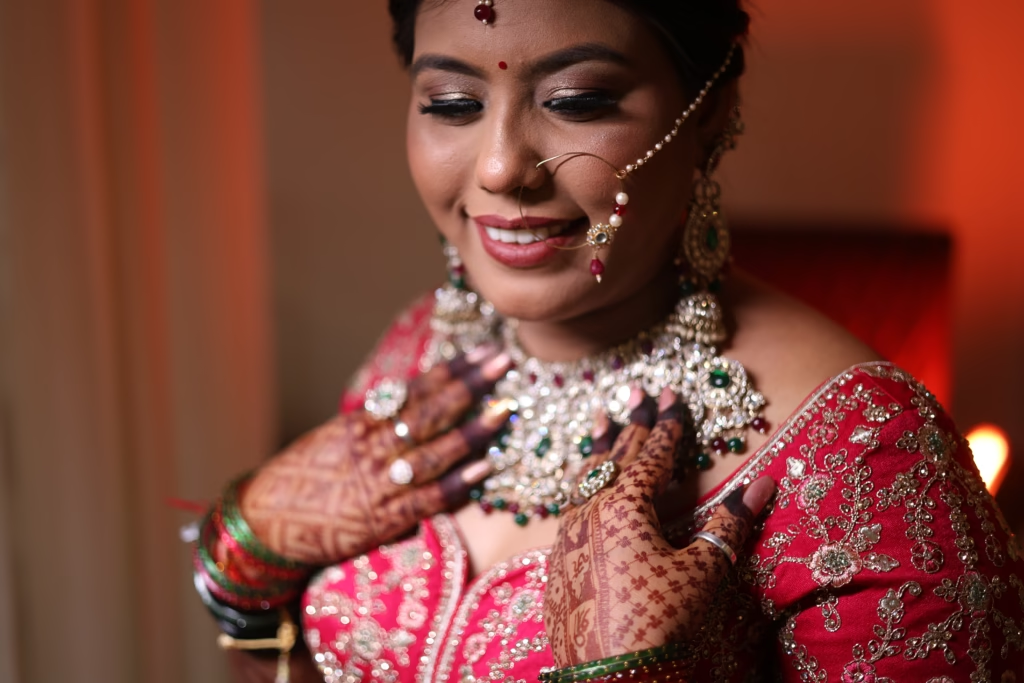
Imagine that the bride is getting ready in her room while the groom’s baraat preparations are happening outside.
At the same time, the bride’s parents are meeting relatives, guests are arriving and the venue is being decorated.
One photographer cannot physically be in all those places.
This is one of the main reasons couples choose a second photographer.
The second photographer is not simply another person taking photographs of the same couple from another angle. When a team is planned properly, photographers can divide coverage.
One may concentrate on the bride and her family while another photographs the groom, guests, décor or activities happening elsewhere.
This becomes particularly valuable during an Indian wedding, where several important moments can overlap.
A Wedding Photographer and a Videographer Do Different Jobs
It is also important not to think of a videographer as simply another photographer with a video camera.
Photography and cinematography serve different purposes.
A photographer is looking for individual frames: expressions, composition, relationships, details and decisive moments that work as photographs.
A videographer is thinking about movement, sound, sequences, reactions and how several moments will eventually work together as a film.
For example, during a varmala ceremony, a photographer may concentrate on the exact expression when the couple exchanges garlands.
A cinematographer is also considering the movement of the couple, reactions from the family, music or ambient sound, the atmosphere around the stage and how those shots will work together in the final wedding film.
This is why adding a videographer is not simply the same as adding another photographer.
Studio Rollii offers both wedding photography and wedding cinematography as part of its wedding coverage options.
How Many People Do You Need for a Typical Indian Wedding?
For a typical multi-function Indian wedding, a 2-person photography team plus 1–2 videographers can provide a practical starting point.
But the requirement should be discussed around the actual wedding schedule.
Consider a wedding with:
Haldi
Mehndi
Sangeet
Bride and groom preparations
Baraat
Wedding ceremony
Reception
Vidaai
You may not need the same number of people at every function.
A smaller Haldi at home may work well with one photographer.
A large Sangeet with performances, family reactions and guests spread across a venue may benefit from additional coverage.
The wedding day itself may require more people because the bride, groom, families, rituals and guests can all demand attention at the same time.
This is why a good wedding photography discussion should begin with the functions and timeline, rather than immediately deciding on a number of cameras.
One Photographer vs Two Photographers
One Photographer
One photographer can be suitable when:
The wedding is relatively small.
Most activities take place at one venue.
The couple does not require simultaneous bride and groom preparation coverage.
There are limited functions.
The photography requirement is straightforward.
The family is comfortable with fewer formal group photographs.
There is also an advantage to having one photographer: the visual style can remain very consistent because one person is responsible for the entire photographic coverage.
But there is a practical limitation.
One person can only be in one place at a time.
If the bride is entering the venue while an important family moment is happening elsewhere, a single photographer has to choose where to be.
Two Photographers
A second photographer becomes useful when there are simultaneous activities.
For example:
Photographer 1: Bride, bridal portraits and bride’s family
Photographer 2: Groom, baraat, guests and venue activity
Later, both photographers can work together during the main ceremony.
This approach provides a more complete record of the wedding rather than simply increasing the number of photographs.
Studio Rollii‘s candid wedding photography approach specifically focuses on natural interactions, family moments, rituals and spontaneous expressions, which is one reason team coordination matters when several things are happening at once.
What About Traditional Photography?
Candid photography and traditional wedding photography should not be treated as interchangeable.
Traditional photography is particularly useful for:
Family group photographs
Important relatives
Formal couple portraits
Ritual documentation
Group photographs with both families
Important guests
Stage photographs
Candid photography has a different purpose.
It focuses more on natural expressions, interactions and moments that happen without everyone looking directly at the camera.
For a large family wedding, having adequate coverage for both can be more important than simply increasing the total number of photographers.
Studio Rollii’s wedding services include candid, traditional, couple, bridal and family photography coverage.
You can explore the dedicated Candid Wedding Photography service by Studio Rollii to understand how this style fits into complete wedding coverage.
How Many Videographers Do You Need?
Videography has a similar consideration: what needs to be happening simultaneously?
For a smaller wedding, one experienced videographer may be sufficient.
For a larger wedding, two videographers can divide responsibilities.
For example:
Videographer 1: Couple, main ceremony and important rituals
Videographer 2: Family reactions, guests, venue atmosphere, performances and secondary angles
This becomes particularly useful during Sangeet performances and large wedding ceremonies where the couple and audience reactions are both important.
If cinematic wedding coverage is a priority, the discussion should also include what you expect to receive: a highlight film, full ceremony coverage, longer wedding film, teaser or other deliverables.
The number of videographers should therefore be decided alongside the final film you want, not simply by the number of cameras.
What If the Bride and Groom Get Ready at Different Locations?
This is one of the clearest situations where an additional team member can make a difference.
Suppose the bride is getting ready at a hotel and the groom is preparing at his family home.
If you have only one photographer, you have to choose one location or divide the available time.
With two photographers, both preparations can be documented naturally.
The same principle applies to:
Different hotels
Different banquet halls
Home and venue preparations
Separate family gatherings
Baraat preparation and bridal preparation
Simultaneous pre-ceremony rituals
Before booking your team, tell your photographer where each important person will be and at what time.
That information can change the recommended team size considerably.
Large Weddings Are Not Just About Guest Count
A common mistake is saying:
“We have 500 guests, so we need three photographers.”
Guest count alone does not determine the requirement.
A better question is:
How many important things need to be photographed at the same time?
A 500-person reception where everyone is gathered in one hall may be relatively straightforward.
A 250-person wedding spread across multiple locations may require considerably more coordination.
Venue layout matters too.
A large banquet hall, farmhouse or hotel may have separate areas for the stage, dining, couple portraits, family gatherings and performances. The physical distance between these areas affects how quickly a photographer can move between moments.
Kanpur Weddings Can Have Another Practical Challenge: Timing
In Kanpur and nearby areas, wedding functions can involve long schedules, traffic between locations and ceremonies that do not always follow the original timetable.
A photography team therefore needs some flexibility.
For example, if the baraat is delayed, the timing of the varmala, dinner, portraits and other ceremonies may shift.
If the bride and groom are getting ready at different locations, travel time needs to be considered as well.
A photographer who has to leave one location, travel across the city and reach another venue cannot cover a moment that happens during the journey.
This is why sharing the complete wedding itinerary with your photography team before the wedding is much more useful than simply saying, “We need photography for the whole day.”
More Photographers Does Not Automatically Mean Better Photography
This is an important point.
Three photographers are not automatically better than two.
If all three photographers are standing around the same stage photographing the same moment, you have increased the headcount without necessarily improving the coverage.
A properly coordinated two-person team can sometimes cover a wedding more effectively than a larger team working without a clear division of responsibility.
The objective should be coverage, not camera count.
A professional team should know who is responsible for the bride, groom, family, rituals, guests, portraits, details and important moments.
That planning is what makes additional photographers useful.
What Should You Ask Your Wedding Photographer?
Before booking, don’t ask only:
“How many photographers will you provide?”
Ask a few more specific questions.
1. How many photographers will actually be present?
The number should be clear in your agreement or booking details.
2. Are videographers included?
Photography and videography are separate requirements. Confirm exactly what is included.
3. Will the team cover both bride and groom preparations?
This matters if the preparations happen at different locations.
4. Is traditional photography included along with candid photography?
If family portraits and formal group photographs are important, clarify this beforehand.
5. What happens when two important events happen simultaneously?
This question tells you more about the team’s planning than simply asking how many cameras they own.
6. Who coordinates the team?
Someone should understand the schedule and make sure important moments are not missed.
7. What happens if a team member cannot attend?
Ask about backup arrangements. Your wedding date cannot be repeated because a photographer became unavailable.
How to Decide the Right Team for Your Wedding
A simple way to think about it is this:
Small wedding + one location + limited functions:
1 photographer + 1 videographer may be enough.
Medium wedding + several functions:
2 photographers + 1 videographer is a reasonable starting point.
Large Indian wedding + multiple functions + simultaneous activities:
2–3 photographers + 2 videographers may be more appropriate.
Large wedding with multiple locations and complex schedules:
Build the team around the itinerary rather than using a fixed number.
These are planning guidelines, not a quotation or mandatory package structure.
Your photographer should be able to look at your wedding schedule and explain why a particular team size makes sense.
The Right Question Is Not “How Many Cameras?”
When couples compare wedding photography packages, they sometimes focus on the number of photographers because it is easy to compare.
But the more useful question is:
“Will the team be able to cover the moments that matter to us?”
That means looking at the wedding timeline, number of locations, functions, family requirements, bride and groom preparations, candid coverage, formal photographs and videography requirements together.
You can also look through a photographer’s wedding photography portfolio and review complete examples of the kind of coverage they produce rather than judging a team only by the number of people they send.
For couples planning a wedding in Kanpur, you can also explore Wedding Photography by Studio Rollii and Candid Wedding Photography in Kanpur to understand the different parts of wedding coverage.
Final Thought
Your wedding does not need the biggest photography team available. It needs a team that is large enough to cover the important moments without getting in the way of the celebration.
For some couples, that may mean one photographer and one videographer.
For a large Indian wedding with several simultaneous events, two or more photographers and additional videography coverage can make a meaningful difference.
The best starting point is your wedding schedule.
Share your date, venues, number of functions, approximate guest count, bride and groom preparation locations, and photography and film expectations with the photographer. A professional team can then recommend the appropriate coverage instead of simply selling you a larger package.
If you are planning a wedding in Kanpur or nearby areas, contact Studio Rollii with your wedding date, venue and functions. The team can discuss the photography and cinematography requirements around your actual schedule.
One Comment
[…] How Many Photographers Do You Need for a Wedding? […]